Speech Therapy for Augmentative & Alternative Communication (AAC)
in Menlo Park & San Jose, CA
Helping You Find Your Voice
Communication goes beyond spoken words. For individuals who are nonspeaking or have limited speech, Augmentative and Alternative Communication (AAC) can provide powerful tools to connect with the world.
At Peninsula Associates Speech Therapy Services, we help children, teens, and adults find the AAC methods that fit their unique needs so they can express themselves with confidence and independence.

What Is Augmentative & Alternative Communication (AAC)?
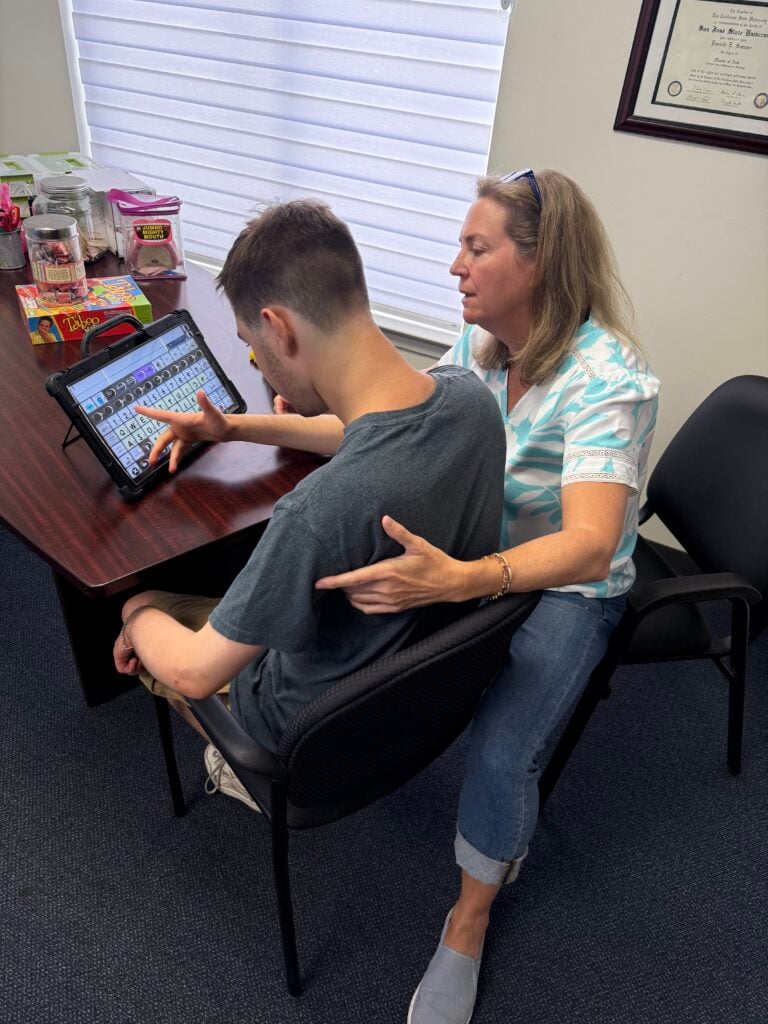
Augmentative & Alternative Communication (AAC) refers to all forms of communication that support or replace spoken language. It empowers individuals with speech challenges to express their needs and share their ideas with others more easily.
AAC ranges from simple communication methods to advanced technology. Some common AAC methods and devices include:
- Picture Exchange Communication System (PECS)
- Communication boards or books
- Speech-generating devices (SGDs)
- Eye-tracking systems
- Sign language
Who Can Benefit from AAC?
AAC can help individuals who experience difficulty speaking
due to a variety of conditions, including:
- Autism spectrum disorder
- Cerebral palsy
- Childhood apraxia of speech
- Developmental delays
- Stroke or traumatic brain injury
- ALS or other degenerative conditions
Discover Our Therapy Approach – Contact Us
How Speech Therapists Help Clients Use AAC Devices & Methods

At Peninsula Associates Speech Therapy Services, our expert speech-language pathologists help clients choose and learn the right AAC method for their unique needs. Whether a client uses a high-tech speech-generating device or a low-tech picture board, we ensure they understand how to use it effectively in real-life situations.
We have extensive experience in AAC, and several of our clinicians have advanced certifications (such as LAMP and PECS) to ensure our clients and families feel confident and empowered throughout therapy.
Frequently Asked Questions
Who can benefit from AAC therapy?
Augmentative and Alternative Communication (AAC) therapy may benefit children, teens, or adults who have difficulty communicating effectively through spoken language alone. AAC can support individuals with speech or language challenges related to developmental delays, autism spectrum disorder, neurological conditions, motor speech disorders, traumatic brain injuries, or other communication differences.
At Peninsula Associates Speech Therapy Services (PASTS), AAC therapy is personalized based on each client’s strengths, communication needs, and daily environments. AAC may include low-tech communication supports, speech-generating devices, tablet-based systems, picture communication systems, or other tools that help individuals communicate more effectively and participate more fully in everyday interactions.
How do you determine which AAC system or device may be the best fit?
At PASTS, AAC recommendations are based on each client’s individual communication strengths, needs, abilities, and daily environments. Our speech-language pathologists consider factors such as language skills, motor abilities, sensory preferences, cognitive skills, communication goals, and the settings where the system will be used most often.
The goal is to identify an AAC system that feels functional, accessible, and practical for the individual and their communication partners. Recommendations may include low-tech communication supports, speech-generating devices, tablet-based applications, or other AAC options depending on the client’s needs. We focus on finding communication tools that support meaningful participation in everyday life.
Do you provide AAC evaluations and support for implementing the system across settings?
Yes. PASTS provides AAC evaluations as well as ongoing support to help clients successfully use their communication systems in daily life. Our speech-language pathologists work to identify AAC tools and strategies that match each individual’s communication needs, strengths, and environments.
Once a system is introduced, therapy may include support for learning how to use the device or communication system effectively across settings such as home, school, work, and community activities. We focus on helping clients and communication partners build confidence using AAC during real-life interactions so communication feels more natural, functional, and meaningful throughout the day.
Can you collaborate with families, schools, and other providers when introducing AAC?
Yes. At PASTS, collaboration is an important part of successful AAC implementation. With appropriate consent, our speech-language pathologists can work closely with families, teachers, school teams, caregivers, physicians, occupational therapists, and other providers involved in the client’s care.
This collaborative approach helps support consistency across environments and encourages stronger carryover of communication strategies in everyday life. We also help communication partners learn how to support AAC use during daily routines, social interactions, academic activities, and functional communication situations. Our goal is to help AAC become a practical and meaningful part of the client’s everyday communication.
What support is available if a device needs technical updates or troubleshooting?
At PASTS, we understand that AAC systems and speech-generating devices sometimes require updates, adjustments, or troubleshooting. Our speech-language pathologists can help guide clients and families through basic support related to device setup, programming, communication organization, and functional use during therapy sessions.
If a device requires more advanced technical support, repairs, or manufacturer-specific updates, families may also need to work directly with the device company or vendor. We strive to support clients throughout the AAC process while helping communication systems remain functional, accessible, and effective for everyday communication needs.
Reach Out Today to Get Started
Everyone deserves a voice. If you or your loved one could benefit from AAC, contact Peninsula Associates Speech Therapy Services today. Our experienced clinicians are ready to help you find the right tools and strategies to support clear, confident communication.